
The Art of Saying Nothing — and Meaning Everything
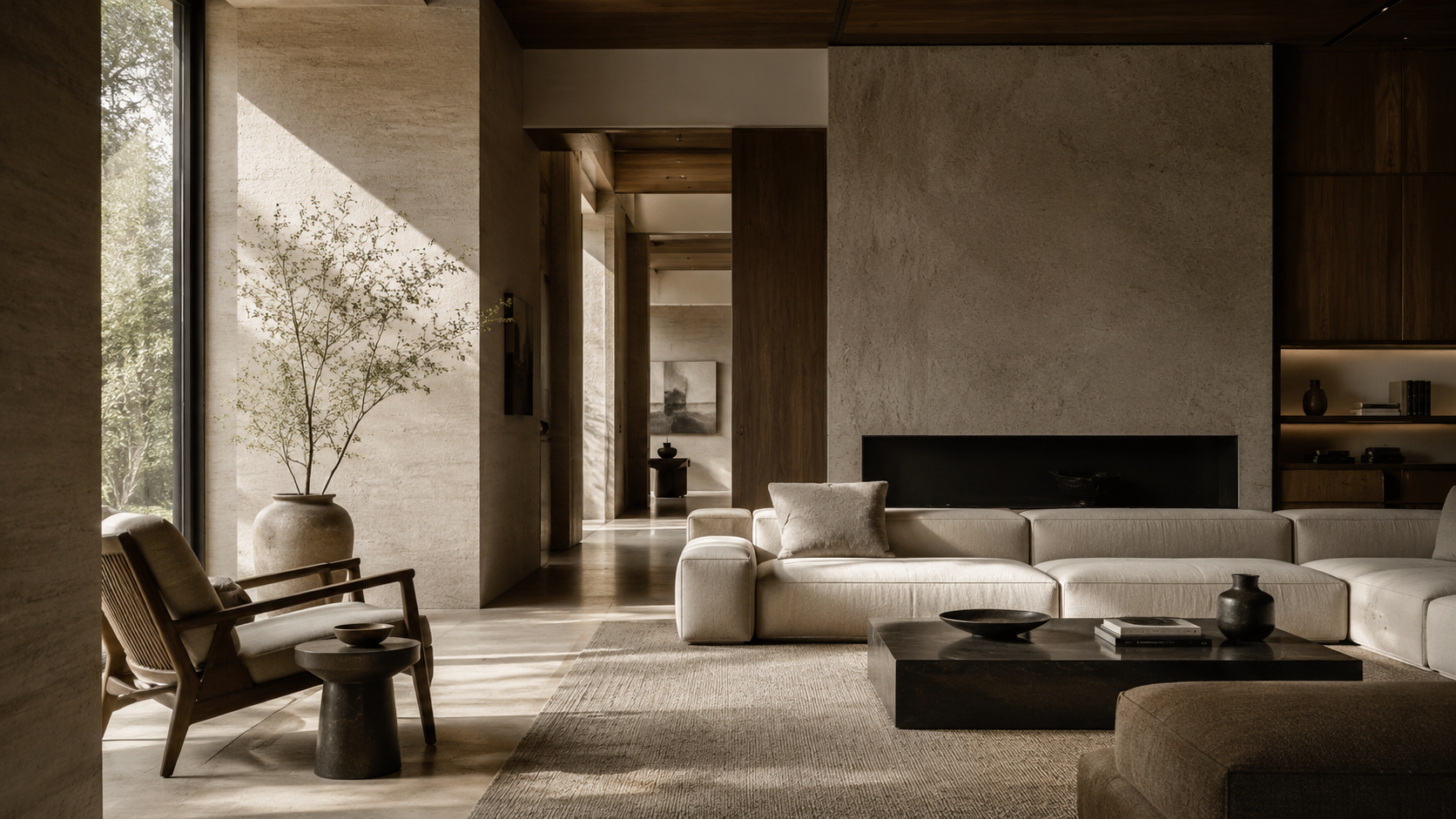
If maximalism is a loud, chaotic dinner party where everyone is talking over each other, quiet luxury is the impeccably dressed guest sitting in the corner, holding a perfectly chilled martini, saying very little but commanding the entire room.
There is a room you have walked into, probably at a hotel, possibly at a friend's home, conceivably in a magazine spread. where nothing, absolutely nothing, screamed for your attention. The floors were pale. The furniture was heavy and low. The art on the wall was one enormous canvas: a single brushstroke the colour of dried grass. And yet, somehow, you felt profoundly aware that whoever designed this room was doing very well for themselves. Perhaps embarrassingly well.
Welcome to quiet luxury, the interior design movement that has made restraint aspirational, understatement prestigious, and the complete absence of colour a power statement. It is, when you think about it, a remarkable achievement. Someone has convinced the world that spending a great deal of money to look as though you've spent almost none is the height of sophistication.
The Paradox at the Heart of It All
Let us be honest about the delicious contradiction embedded in quiet luxury. The entire aesthetic is predicated on having enough confidence — and enough financial runway — to resist the temptation of showing off. It is conspicuous consumption wearing a monk's robe. The Loro Piana throw on the daybed costs more than a decent second-hand car. The travertine kitchen island is quarried from the same stone as the Colosseum. The linen curtains were likely hand-hemmed by someone in an atelier who goes home to a less quiet apartment.
“The quieter the room, the louder the money. This is not irony, it is the entire point.”
And yet, despite or perhaps because of this contradiction, the aesthetic has genuine power. When executed with real intelligence, a quiet luxury interior does something remarkable: it puts the human being at its center. You are not competing with the wallpaper. You are not upstaged by the chandelier. You are simply, elegantly, present. Which is, when you strip away the socioeconomic subtext, actually rather lovely.
A Brief, Biased History
Quiet luxury as a named trend is new. Quiet luxury as a sensibility is ancient. The Shakers built furniture of such profound simplicity that it is still being copied four centuries later. Japanese wabi-sabi has spent millennia insisting that imperfect, weathered objects contain the highest beauty. Minimalism arrived in the 1960s wearing a turtleneck and telling everyone that less was more though it tended to be rather cold about it.
The modern chapter begins somewhere between the rise of "normcore" fashion (2014), the inevitable backlash against maximalist interiors stuffed with gallery walls and neon signs, and the cultural exhaustion produced by Instagram aesthetics. By 2022, the algorithm was surfacing endless footage of cream-coloured apartments with arched doorways and unread hardbacks arranged by spine colour. By 2023, it had a name. By 2024, it was available at IKEA.
This is, of course, the moment any trend becomes philosophically complicated.
The Seven Commandments (According to Those Who Know)
I Thou shalt not pattern-clash
Texture is your only permitted complexity. Boucle against linen. Travertine against oak. Brushed brass against matte plaster. The interplay of materials does all the work that pattern used to do but with considerably more dignity.
II Thou shalt invest in the invisible
The most expensive things in a quiet luxury room are the things nobody notices: the quality of the plaster finish, the weight of the door handles, the depth of the skirting boards, the precision of the joinery gaps. This is where the real money goes, and the real skill lives.
III Thou shalt let the architecture speak
A truly quiet luxury interior does not fight its bones, it amplifies them. A Victorian arch gets plastered and celebrated. An industrial beam is exposed and celebrated. The space already has something to say; the designer's job is to stop interrupting it.
IV Thou shalt be deliberate about light
In quiet luxury, light is not functional. It is compositional. The room should behave differently at 7am, at noon, and at dusk. Layered lighting, low pendants, recessed dimmers, a single floor lamp in the corner is non-negotiable. The overhead grid alone is a war crime.
V Thou shalt edit mercilessly
Every object in the room must justify its existence. Not because you are a minimalist (you are not — you have six different textures of cushion) but because visual noise destroys the feeling of ease you're trying to manufacture. The editing process is the most important design decision of all.
VI Thou shalt age things correctly
New is the enemy. Quiet luxury wants patina, provenance, and the gentle signs of time. An inherited kilim. A vintage brass lamp with a slight verdigris. A piece of furniture that "has a story." If you can't afford the real thing, lightly distress it and tell no one.
VII Thou shalt never over-explain
If a guest asks about anything in your home, the answer is never "I found it on a really great website." It is a long, vague story involving a market in Lisbon, a grandmother, or an architect you once knew. The mystery is load-bearing.
The Palette Question
No conversation about quiet luxury interiors can avoid the colour question, so let us address it directly:
Yes, there are other colours beyond greige, warm white, mushroom, bone, chalk, and the seventeen variants of brown that have been given names like "aged linen" and "truffle." They simply require more confidence to deploy.

The sophisticated quiet luxury interior actually uses color, it just uses it in the way a great actor uses silence. A single room with warm stone walls might have one wall of deep forest green. An otherwise ivory apartment might have a bathroom of floor-to-ceiling midnight blue Zellige. The color lands harder because everything around it has been quieted. This is, frankly, more impressive than a maximalist room where no individual element can breathe.
The designers worth watching, Axel Vervoordt, Vincent Van Duysen, India Mahdavi at her most restrained, Ryan Korban, all understand that the neutral backdrop is not the destination. It is the stage.
When It Goes Wrong (A Gentle Taxonomy of Failure)
Quiet luxury executed badly is among the saddest things in interior design. It produces rooms that feel not calm but deflated. Not restrained but frightened. Not serene but simply beige. Here is how it tends to happen:
The Budget Mismatch. Quiet luxury at low price points is extremely difficult to pull off because the aesthetic relies on quality of material doing the heavy lifting. A cheap boucle sofa does not have the same presence as a well-upholstered one. The proportions sag. The texture looks like a novelty oatmeal sweater rather than something from a Milanese showroom. This is not a moral failing, it is simply physics.
The Joylessness Problem. There is a version of this aesthetic that tips from restful into austere, from curated into clinical. If your home no longer shows evidence of human habitation, if the books are arranged spine-out, if there are no flowers in an actual vase, if the children's drawings have been sent to a storage unit you have crossed from design philosophy into controlled environment. Come back.
The Trend Trap. The arched doorway. The limewashed wall. The concrete-look tile. The curved sofa. The fluted wardrobe front. These are all lovely. They are also now so ubiquitous on social media that a room composed entirely of them reads less as curated taste and more as very attentive scrolling. The true quiet luxury move is to know which of these you would have chosen regardless of Instagram.
“A room should feel like it belongs to a person, not to a trend cycle. The moment it could belong to anyone is the moment it belongs to no one.”
The Architecture Question — Where the Real Action Is
Interior design gets the attention, but interior architecture is where quiet luxury actually lives or dies. You can put all the cashmere throws in the world on a poorly proportioned room and it will still feel wrong. Quiet luxury, at its architectural core, is about spatial generosity: ceiling heights that don't feel accidental, rooms that flow into one another without announcing the transition, storage that disappears into walls so completely that the room seems to breathe.
The architects who have built their careers around this ; Vincent Van Duysen, John Pawson, Kengo Kuma in a different tradition, all share an obsession with the threshold. How you move from outside to inside, from public to private, from one room to the next. Every transition is an opportunity to calibrate the feeling of the space. Get those transitions right and the furniture almost doesn't matter.
Practically, this translates to: continuous flooring materials that run from room to room without interruption. Doors that are concealed within walls (expensive but transformative). Window proportions that are considered rather than accidental. Built-in storage that makes the room feel complete rather than furnished. These are architectural decisions, not decorating ones, and they require either a substantial budget, a genuine architect, or the willingness to live with a construction site for several months.
The Verdict: Is It Worth It?
✦ Yes, but not for the reasons you think
Quiet luxury is worth pursuing not because it's fashionable (it will become unfashionable, probably quite soon, and something more textured and exuberant will take its place) but because the underlying principles are genuinely good ones. Invest in quality over quantity. Let the architecture do the work. Edit until what remains is only what you love. Consider how light moves through the space. Let the room age into itself. These are not trend-dependent ideas. They are just intelligent ways to live.
The paradox of quiet luxury is that the loudest statement it makes is about the character of its inhabitant — their patience, their confidence, their willingness to choose what is right over what is obvious. Which is, of course, the oldest definition of good taste there is. It predates the arched doorway by several thousand years. It will outlast whatever comes next.
Just perhaps consider hanging something on the wall that isn't beige. One single thing. For the rest of us.
